How much does pool deck resurfacing cost in Arizona?
Published 2025 and 2026 guides put Arizona pool deck resurfacing at $3 to $25 per square foot. Options range from coatings to pavers. A typical 600 square foot deck runs about $2,000 to $15,000, from a basic overlay up to a full tear out and new pour.
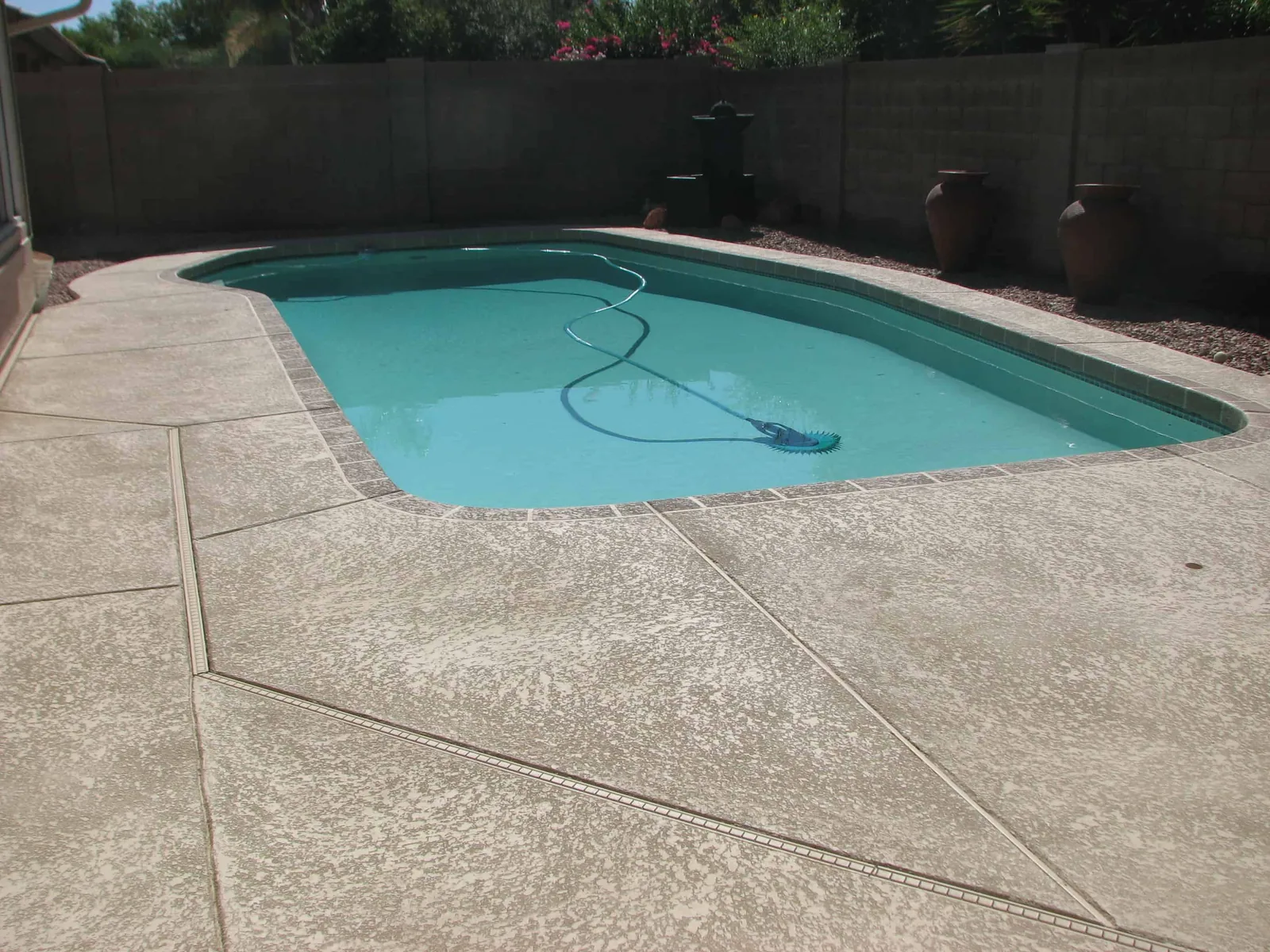
A stained, worn, or too-hot-to-touch pool deck is a common call for East Valley homeowners. Resurfacing options range from a sprayed acrylic coating to a full tear out and new pour. Prices swing just as wide. This guide breaks down what each option costs in Arizona right now. It also connects the choice to new pool deck and deck extension work.
This guide covers the deck, the concrete you walk on around the pool. It does not cover replastering, which redoes the pool’s interior surface underwater, a different job with different materials. Every dollar figure below comes from published 2025 and 2026 market guides, not a DC Construction quote. A look at the property gets you a real number, with a free estimate.
What does pool deck resurfacing cost by option in Arizona?
Published 2025 and 2026 guides put Arizona pool deck resurfacing at $3 to $25 per square foot. The low end covers a basic concrete overlay, and the high end covers pavers. Acrylic coatings and stamped overlays fall in between, and a full tear out usually costs the most.
Each option starts from a different point, and fits a different level of wear. Acrylic cool deck coatings and concrete overlays go over a deck that is still structurally sound. Stamped overlays borrow the same look as stamped and decorative concrete, applied on top of the existing slab. Pavers go down once the old deck is leveled and framed at the edges.
A full tear out removes the old concrete and pours a new deck from the ground up. The table below lines up published cost ranges for a typical 600 square foot Arizona pool deck. For how these compare to concrete pricing generally, see what concrete costs per square foot in Arizona. Cost still depends on size, condition, and access, covered next.
Arizona pool deck resurfacing options and published 2025 to 2026 cost ranges
| Option | Typical installed cost per sq ft | Typical 600 sq ft deck | Best for |
|---|---|---|---|
| Acrylic cool deck coating | $4 to $8 | $2,400 to $4,800 | Refreshing color and lowering surface heat on a sound deck |
| Concrete overlay or microtopping | $3 to $6 | $1,800 to $3,600 | Smoothing small cracks and stains on a solid deck |
| Stamped overlay | $7 to $20 | $4,200 to $12,000 | A new decorative pattern and texture |
| Pavers over the existing deck | $10 to $25 | $6,000 to $15,000 | Changing the look without demolition |
| Full tear out and replacement | $10 to $24 | $6,000 to $14,400 | Structural cracks or heavy damage |
What drives the price of a pool deck resurfacing job?
Deck size sets the baseline, since every option is priced per square foot. Beyond that, condition drives the biggest swings. Cracks, stains, uneven areas, and drainage problems add cost before the new surface goes on. Coping, color, texture, demolition, and access all move the price too.
A bigger deck costs more overall, but the per square foot price often drops as the job gets larger. Condition matters more than size: hairline cracks cost less to prepare than wide cracks or heaving. Crack repair runs roughly $1 to $3 per linear foot, more for structural cracks. Why concrete cracks in Arizona covers what usually causes the damage.
A drainage fix, like regrading or an edge drain, can add a few hundred to several thousand dollars. Coping style, color, and texture add cost on top of the base price. Demolition and haul off run about $2 to $6 per square foot on top of a tear out. Hard-to-reach decks, behind a gate or down steps, cost more to prepare.
When does resurfacing work and when should the deck be replaced?
Resurfacing works when the slab underneath is sound. The problems have to be on the surface: staining, fading, minor cracks, or a rough, hot texture. Replacement makes more sense when cracks run through the slab or sections have settled. It also fits when the deck holds water against the house or pool wall.
A deck that is structurally sound is the best candidate for any resurfacing option in the table above. That means it holds its shape and drains the way it should. A coating, overlay, or paver layer then gives it a new surface without a full rebuild. A deck extension or a new pour is a different project with its own price.
Deep or structural cracks are the clearest sign a deck has moved past resurfacing. So is a section that has settled unevenly, since a new surface layer will not fix what is happening underneath. Tear out and replacement is the more reliable fix. It is covered on the concrete repair and tear-out page, alongside crack repair for driveways, patios, and slabs.
How does Arizona sun and monsoon change the choice?
Color and texture change how hot a deck gets underfoot. Testing from Lawrence Berkeley National Laboratory found light-colored pavement runs cooler than dark pavement in direct sun. The difference measured about 30 degrees Fahrenheit. Arizona pavement has been measured well above 120 degrees Fahrenheit on summer afternoons, hot enough to burn skin quickly.
Dark pavement absorbs 80 to 95 percent of the sunlight that hits it, per Berkeley Lab research. New concrete reflects more sunlight than asphalt before it ever gets a coating. An EPA pilot study in Arizona found that asphalt paving can reach around 150 degrees Fahrenheit at midday. A cooler-surfaced pavement in the same study ran 10 to 16 degrees cooler.
Lighter colors and cool deck style coatings use that same principle to lower surface heat. Kool Deck is one of the oldest names in pool deck resurfacing, invented by Mortex in Tucson in 1962. Knockdown acrylic coatings today still use that idea, a tinted topping that runs cooler than bare gray concrete. Darker colors show sun wear first, so color choice matters.
When is the best time of year to resurface a pool deck in Phoenix?
Fall through spring is the easier window for pool deck work in the Phoenix area. Arizona’s monsoon season runs June 15 through September 30, per the National Weather Service. Afternoon storms in that window can rain out a coating mid-cure. Summer heat also pushes past what coating manufacturers allow.
Coating and overlay products cure best in a set temperature window. One manufacturer’s data sheet lists an application range of 50 to 90 degrees Fahrenheit, air and surface. A Phoenix summer afternoon regularly runs past that mark. Arizona pavement has measured well above 120 degrees Fahrenheit in June. Monsoon rain during the cure window can also blister a fresh coating.
Cooler months, roughly October through April, give a coating or overlay time to cure. There is less risk of a rain delay or a heat problem. A full tear out and new pour has more flexibility, since fresh concrete can be placed in summer too. In the hottest months, crews pour before sunrise to beat the heat. Monsoon timing matters too.
How long does each pool deck resurfacing option last?
Lifespan varies by option. Acrylic cool deck coatings typically last 5 to 10 years before a full recoat. Trade sources report 10 to 12 years for a well-installed coating in the Phoenix area. Concrete overlays commonly hold up 10 to 15 years. Pavers and a full replacement last decades.
An acrylic coating fades and wears faster than the concrete underneath it, so it is rated in years, not decades. Dark colors, standing water, and slab movement all shorten that window. A concrete overlay or microtopping is thicker and more durable, and some manufacturers back these systems for around 5 years. Sealing on schedule extends the life of either option.
Industry sources rate pavers at 20 years or more when properly installed. Concrete versus pavers in Arizona covers how the two compare beyond the pool deck. A full tear out and new concrete pour is the most durable option, lasting decades on a well-prepared, well-drained base. A single damaged paver can also be swapped out without redoing the whole deck.
A look at your deck is the only way to get a real number for your project. Contact DC Construction and Development for a free estimate. Or see our concrete pool deck page if a new deck or an extension fits your plans better.